Tuesday, September 11, 2012

Experiment 3: Thirsty Flowers


Objectives: To observe how plants use their stems to get water and to compare what I expect to happen with what I observe to happen.

Predictions:   If I put a white carnation into a glass of blue colored water I think that all the petals will turn blue, starting from the center and spreading outwards from there. I don’t think that you will see the colored water in the stem as it colors the flower blue. If you add yellow to the flower, the flower will turn green.


Observations:

Here is the white carnation:


The carnation has fluffy white flowers, dark green stem, and dark green leaves.

Here is the white carnation split in half:


The carnation split in half has leaves extending into the stem, light green stem interior, and the petals extend into a light green bulb.

When put in blue dye for a few seconds, the inside of the stem turned blue. 

After half an hour, the carnation looked the same, except that it had a dark blue tip.

After two hours, the carnation’s petals started to turn blue around the outside edges.

After twenty and a half hours, the carnation looked the same.


Results:

On the cross section of the flower in the blue water, there are blue lines starting from the end of the stem, running through the stem and the petals and collecting on the outside edge of them. In comparison, on the cross section of the flower in the clear water, the stem is green, the petals are plain white, and there don’t appear to be lines of any kind on it.

On the petals on the flower in blue water, there are blue lines running through petal in scale-like patterns, starting from the end of the petals and collecting on the outside edge of them. In comparison, the petals on the flower in clear water doesn’t appear to have any scale-like details on it.

On the leaves and bulb on the stem of the flower in the blue water, there is a blue blob on the base of each leaf and a blue diamond shaped pattern on the bulb of the flower. In comparison, the bulb and leaves on the stem of the flower in the clear water are green.

Conclusion:

I thought that all of the petals of the flower would turn completely blue but what really happened was that the petal’s edges turned blue and the petals developed a scale-like pattern. The reason this happened is because the colored water is moving up through the xylem in the stem, which is the tissue that draws water and nutrients up through the soil.

Sunday, September 9, 2012

Lego Models

Here are some Lego creations I have made and taken pictures of. Enjoy!

A hovertrain with a hinged feature I learned from a Lego Advent Calendar, allowing it to be posed. Its wings are made from sideways pieces. 


A spaceship made using a technique I discovered. It also uses rubber bands to make colored lines on it.


The backside of the spaceship, showing the technique of sandwiching a technic piece between two bricks.


A spaceship with a laser on a crane arm. It was built using sideways building.

A shape-changing spaceship that changes into a robot, a submarine, and a robot creature. It does not use any interesting techniques.


A bipedal robot inspired by steampunk (v.1). He was built using a walking base.


 A wind-up car created using a technic book I bought at Legoland Florida. You move it by winding it up and then letting go on the floor. 


A sea-faring robot inspired by steampunk. He was built using a handlebar to connect his upper half to his lower half.  


A miniature working cargo spaceship inspired by pictures from a Lego blog I like to read. Here is the link to it.


 A crayfish posted on my blog here. He was built with a modified piece at the center.


A bipedal steampunk robot. He was built with a walking base I figured out how to build.


A dinosaur under a tree who I posted about here and here.

A glider built for a Lego Master Builder Academy design challenge. Visit the website here.

The glider canopy.

Wednesday, September 5, 2012

Bio 2


Objective: To observe many of the different jobs needed to run a household and to observe how all the jobs parents do are connected to other jobs performed by other people.

Observations: 

These are some of the jobs my mom and dad do:

Make and serve my meals.

Get my personal care.

Clean up after meals.

Clean the house.

Take care of the pets.

There are many tools and items my mom and dad need to do these jobs. For example, for the job of making and serving meals, my mom and dad need:

Toaster

Oven

Mixer

Bowls

Food

Rolling pin

Measuring spoons 

Store bought and garden vegetables and herbs

Sink

Silverware


Now I’m going to look in more detail at one of the items. That item is store-bought food. The food came from a grocery store. The food was made by a food manufacturing company and brought to the grocery store in boxes in a truck. The item is made of raw food grown from a seed at a farm. 


Results:

My mom and dad do approximately two dozen jobs.  My mom and dad need approximately fifty different things to make and serve meals.  Some of the people needed to make the food are listed here: farmer, truck driver, food manufacturing supervisor, food boxing supervisor, truck driver, grocery store supervisor.

If my mom or dad had to make all of the things needed to make and serve the meals, there would be approximately 120 jobs.  Some of the jobs would be to make bowls. Here are the tasks: mine the silicon, melt the silicon into plastic, cut a tree apart to make a mold of a bowl, pour the silicon into the mold, eat out of bowl.

I discovered that if you had to make all the things in this house yourself, there would be approximately 1,200 jobs to do. I got that number by writing down the approximate number of tasks for making three things in this house (35 jobs), taking the average of the jobs (12 tasks per object), and multiplying it by the number of types of objects in the house (about 100) to get around 1,200 jobs. That assumes that you have to start over every time you make something. A few of the jobs are for making curtains: get wool or silk from a sheep or spider, weave the wool or silk into cloth, gather plants to dye the curtains, crush the plants to make dye, sew the curtains, dye the curtains, and hang the curtains. 

I think that it is very helpful to have a city that makes these things for you. The city makes the processes for making the things in our home easier and simpler. Also, the items are better quality because companies have specialized machines that help manufacture the items that you need. If my mom or dad had to make all the things in our home, they wouldn’t have time to help us do things.

Conclusion: 

If the jobs in the cell are not done, the cell will stop functioning. In a city, if the city stops performing its services, trash will pile up, making us sick, people will die from no emergency services and the roads will crumble, among other things. Nobody will be able to live there and the city will die like the cell.

In our home, if we don't keep it clean, make food, take out the trash and other critical chores, then we won't be able to live here. This is just like the cell and the city. Everything has to be maintained or it will fall to ruin.

Tuesday, August 28, 2012

Biology


Objective: To sort different objects into different groups.

Observations:

Descriptions for objects:


Objects are sorted by descriptions into five groups:
Results:  What did I discover.

I observed that the objects fit into three main categories, building materials, balls, and food, but as I looked at them I saw more and different things about them. Because of that, it was very hard to pick five groups for them to fit into without listing the objects twice. 

Even though the objects are similar, they still have differences. For example the building material objects were all used as building materials but some were rectangular and they could have fit with the rectangular objects. The round objects were all balls but some were multicolored and could have fit in the multicolored group. The food objects were all food but some of them were round and could have fit in the round group. It is very hard to get a perfect sorting system because the objects have many different characteristics.

Conclusion: 

There are many ways to sort things, size, shape, etc. but once you start inspecting the objects, it is very hard to know how to sort them so that they are only used once in each category because they have so many characteristics. 

Application:

I am an explorer and found a new creature on a new planet.  It is green, eats flies, lives in trees, and flies with wings.  I can group it with frogs, monkeys or butterflies. I am going to group it with butterflies because butterflies can be green, can fly, and can live in trees. Here is a picture of it:


Monday, August 20, 2012

My Mom's Birthday Cake

It's my mom's forty-fourth birthday today and the cake was delicious. Here it is before we ate it. Enjoy!

The cake.

That's not my post.... 
Here is my Lego cake for my mom's forty-fourth birthday that is today. It's supposed to look like a pond. The first four represents my mom's love of gardening, and the second four represents our house that my mom has decorated and painted. Enjoy!

Wednesday, August 15, 2012

Postcards

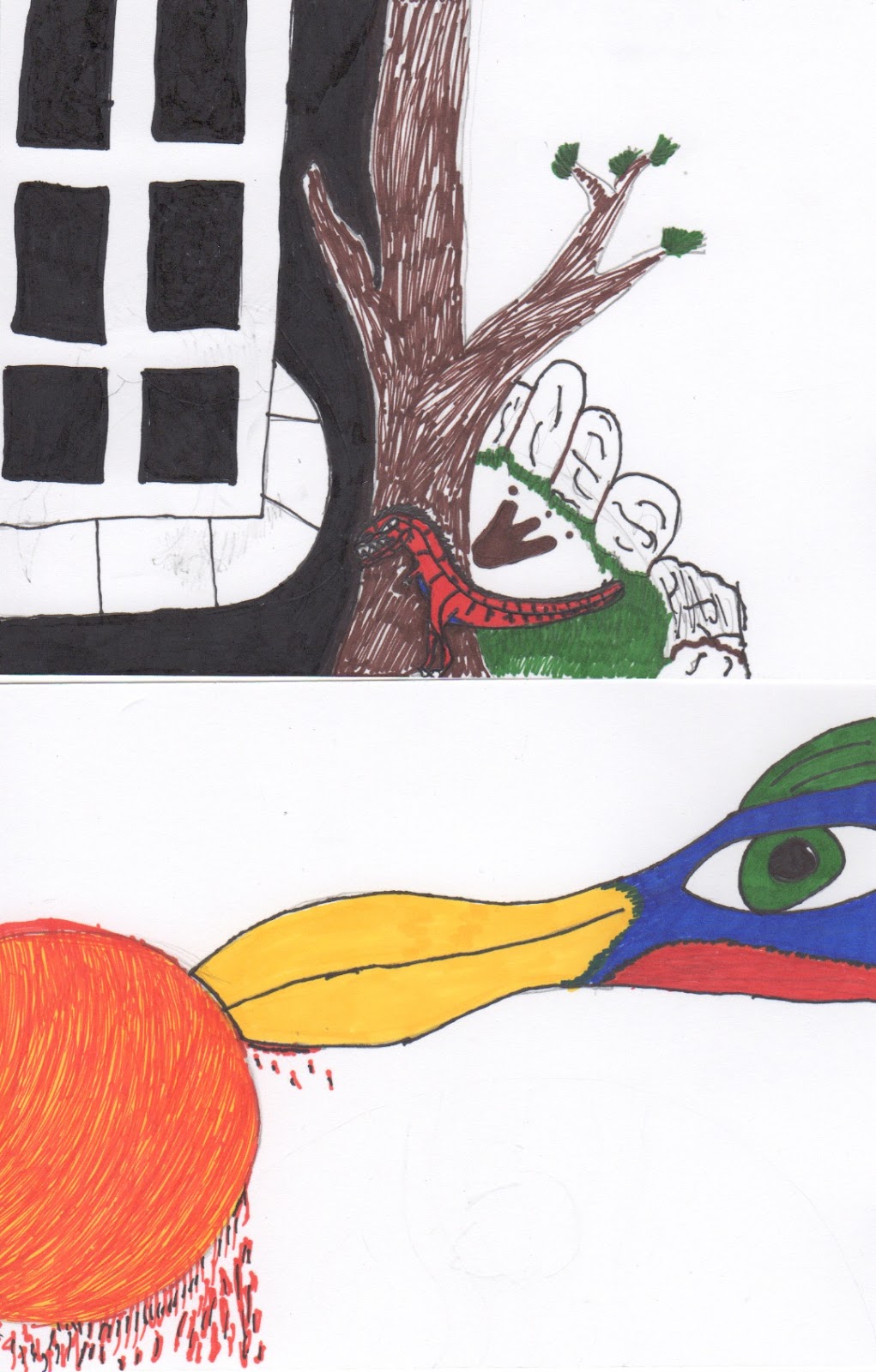
Here are some postcards I have made. The first postcard displays ancient time vs. modern times and how different they are. The second is a hummingbird eating a piece of fruit. Enjoy!